
Jefferson City Previous Residents by Era
One house can have several usable trails. Cole County land records identify transfers and parcel descriptions. Historic directories and census schedules can add a dated household clue. Permits, probate files, maps, and obituaries often help explain a change between those sources. The useful question is not simply who owned a building, but what record was made at the time and what it can actually establish. Online access is uneven, especially before the modern Recorder series, so a serious search should retain the book, page, and repository for every finding.
| Source | Years It Covers | Where Held | What It Shows |
|---|---|---|---|
| Recorder reference index | References records back to 1821 | Cole Recorder and iCounty series | Grantor, grantee, document, and legal-description trail |
| REAL deed books | Full June 1980-current; partial Oct. 1969-May 1980; historic books 1-50 include 1872-1943 ranges | iCounty, Recorder counter, and Archives | Transfers and parcel continuity, with series-specific online depth |
| QCD and will books | QCD 1884-1932; wills 1869-1946 | Historical image/book-page series and Probate | Quitclaim or estate bridges in an ownership trail |
| Jefferson City directories | 1904-05, 1908-09, 1921, 1925, 1929, 1931, 1933, 1935, 1948, 1952-53, 1955 | SLCL inventory; ask MRRL locally | Address, subscriber, household, or business clues |
| Federal census | 1830-1930 at the Archives; 1940 image and street-index route; later releases follow 72 years | Missouri State Archives and NARA sources | A household on one enumeration date, not an annual roll |
| Sanborn and permit leads | Sanborn leads: 1885, 1892, 1898, 1916, 1923, 1939; permit start year not posted | Historic reports, SmartGov, and Laserfiche | Building and address-continuity context |
Start with the most recent verified parcel, then move backward only when the legal description or another independent record supports the match. A blank year in a directory run is a collection gap, not proof that past residents left the address.
Freeze a Jefferson City Address Record
Begin with the public Cole County DEVNET real-estate search. Its basic form accepts a parcel number, owner name, house number, street name, and city, with at least one field required. Save the situs address, parcel number, legal description, current owner, mailing address, and tax year before going further. The situs address identifies the parcel location. The mailing address tells the county where a tax notice goes. It can be useful context, but it does not prove that the named owner lived there.
For older work, the legal description is the key. A parcel number on a current card may not appear in an older deed index, while a lot, block, subdivision, or metes-and-bounds description can survive a street-name change. The Cole County Assessor maintains an office terminal, maps, and public-record access at 210 Adams when a detail is not exposed online. Detailed or multiple-record research can require a visit and may involve reproduction or preparation charges.
Cole County Deeds for Past Residents
The Recorder of Deeds is the backbone for tracing past residents who owned the parcel. Search the present owner as the grantee in the Cole iCounty Recorder portal, then record the conveyance into that owner. Its seller, the grantor, becomes the next search name. Search that seller as a grantee to locate the earlier purchase, and repeat the process while comparing the legal description every time. A name-only match is weak when names, trusts, or business entities repeat.
- Copy the current DEVNET owner, parcel number, and legal description exactly as shown.
- Find the deed that conveyed the parcel to that owner and note its grantor, grantee, recording date, document type, and book/page or document number.
- Search that grantor as a prior grantee, then test the next deed against the same lot, block, subdivision, or survey description.
- Check related deeds of trust, releases, plats, easements, restrictions, and probate instruments when a transfer does not resemble an ordinary sale.
- When the applicable series ends online, ask the Recorder or State Archives for the cited book/page, index spelling, or reel rather than requesting a title opinion.
- Grantor and grantee
- The grantor transfers an interest. The grantee receives it. Reading each person in the correct role lets the chain move backward.
- Chain of title
- A chronological set of property transfers. It is research evidence, not a legal title abstract.
- Legal description
- The lot, block, subdivision, survey call, or other formal parcel description. It is often more durable than a street address.
- Criss-cross directory
- An address-ordered directory that can supply an occupant or subscriber clue for a particular year.
Jefferson City iCounty Date Boundaries
The Recorder describes a general reference index back to 1821, but that does not mean every deed has the same online index fields or image access. REAL books 261 through current are listed as full from June 1980 forward, while books 216 through 260 are partial for October 1969 through May 1980. Historic REAL books 1 through 50 contain ranges from 1872 to 1943. QCD books 1 through 6 cover 1884 to 1932, and will books 1 through 3 cover 1869 to 1946.
There is a real series discrepancy to preserve. The county Functions page describes a digital full index beginning in July 1983 and a partial index from October 1969 through June 1983. The online-records table gives June 1980 for the REAL full series. Cite the book or series used instead of flattening those statements into one promised cutoff. iCounty images require a paid account; the counter, microfilm, historic book pages, and State Archives reels remain the fallback route.
Cole iCounty's recorder landing page shows the account-based entry point for this portion of a Jefferson City previous-residents search.
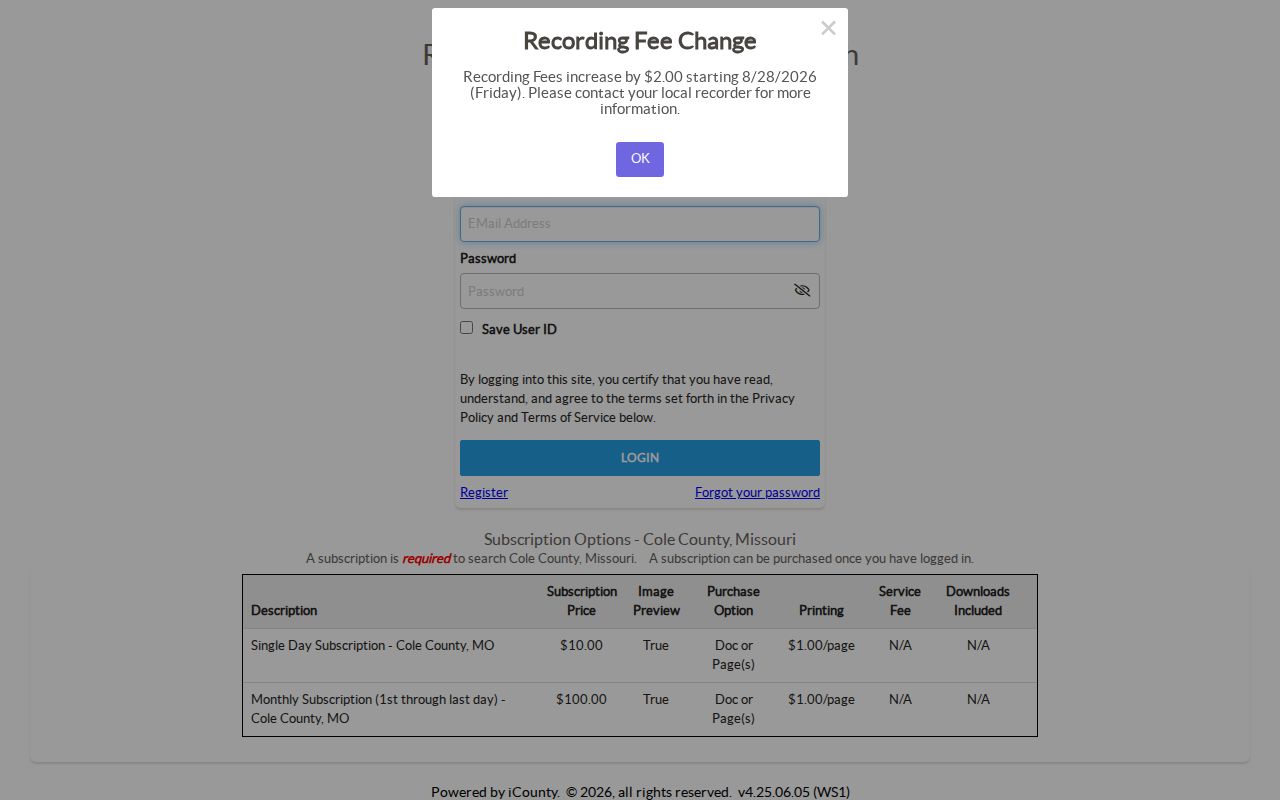
The screen is a reminder to capture the applicable series and document reference before assuming that an older image will be available through the same online route.
Jefferson City Past Resident Directory Years
The published local directory leads are discontinuous. The St. Louis County Library inventory lists Jefferson City volumes or microfilm for 1904-05, 1908-09, 1921, 1925, 1929, 1931, 1933, 1935, 1948, 1952-53, and 1955. Check the title page and abbreviation key before drawing a conclusion from an entry. Publisher names for those exact holdings were not verified in the inventory, and no complete local run should be assumed.
Missouri River Regional Library at 214 Adams provides genealogy and local-history help, including city directories, yearbooks, newspapers, and database leads. Its public service page does not promise a particular Jefferson City reverse-directory year or obituary index. Ask the reference desk for the address-order, telephone, newspaper, or local-history material that fits the target year. The broader shelf and how to read it are addressed on the Jefferson City city directory collections page.
The MRRL local-history service listing is a useful starting point for choosing a library counter rather than assuming a digitized directory exists.
Use the listed service to ask for the exact volume, reel, newspaper, or yearbook that fits the address and date under review.
The Library of Congress city-directory guide helps distinguish alphabetical, address-order, business, and telephone entries before an old volume is read.
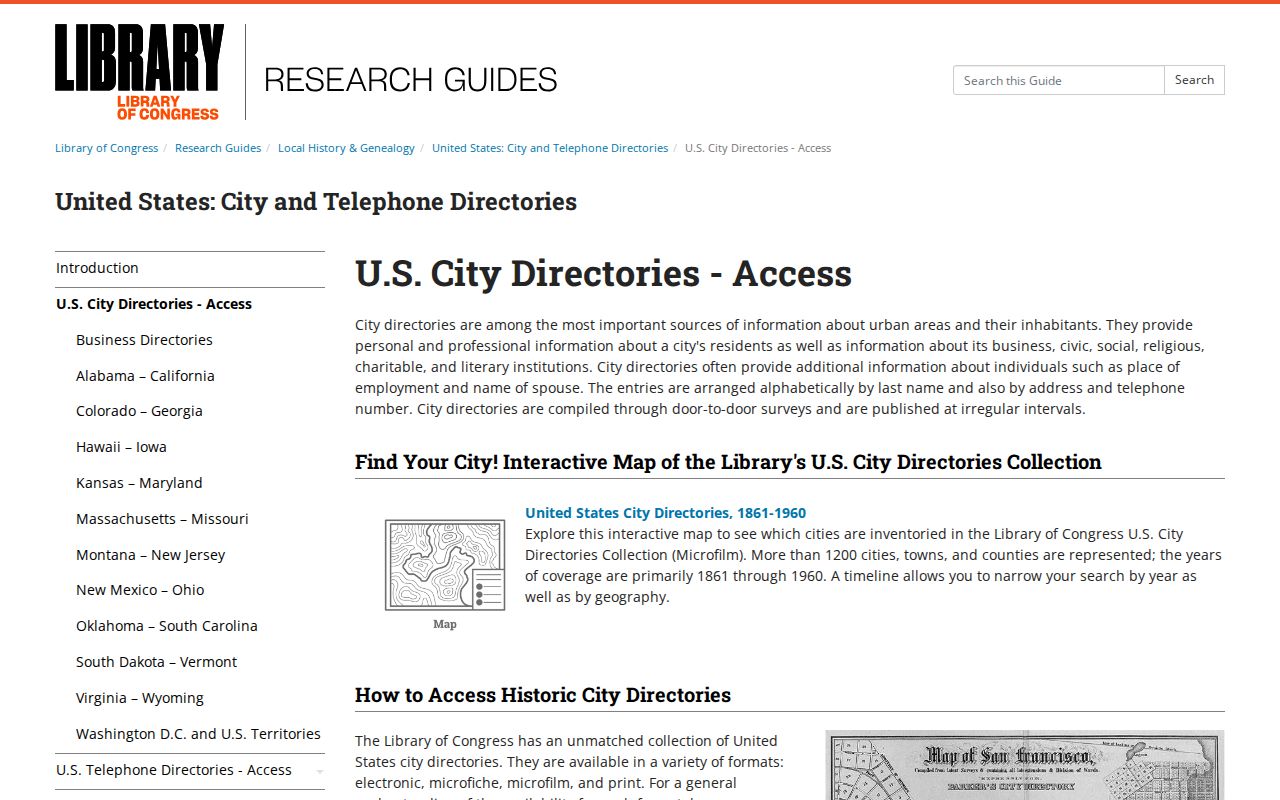
The local title page and its abbreviation key still control what a particular Jefferson City volume actually records.
Note: An address entry may name a subscriber, business, or household contact, so pair it with another dated source before treating it as an occupancy finding.
Census Snapshots of Jefferson City Past Residents
Directories provide a compilation-time clue; a census places a household on its enumeration date. Pair a directory year with the closest released federal schedule, then compare names, address wording, household composition, and source date. Missouri State Archives lists federal schedules for 1830 through 1930 and provides a 1940 image route with a Jefferson City street-name index to enumeration districts. Later federal releases follow the 72-year rule, so census material is never a current address list.
A practical household sequence is short and repeatable:
- Write down the directory's address, spelling, year, and any printed relationship, work, or phone notation.
- Use the historic street name and the 1940 street index, where relevant, to narrow the enumeration district before browsing images.
- Compare the household with a deed or parcel description, then record whether the match is direct, tentative, or contradicted.
- Move to the next available directory or released census, keeping the gap visible rather than assuming a move occurred.
The 1890 federal population schedules were destroyed. The separate 1890 Civil War-veteran material is a different source and should not be treated as a replacement household census.
Sanborn Clues for Jefferson City Addresses
Historic addresses can drift even when the parcel survives. Jefferson City's historic-district material records that Sanborn mapping was used to locate former businesses because addresses had changed. Verified Sanborn leads are 1885, 1892, 1898, 1916, 1923, and 1939, though a direct official digitized viewer was not located. Use those maps with plats, legal descriptions, city ordinances, and the current parcel card rather than converting an old address directly to a modern one.
The city staff record is evidence that address continuity can be difficult, not proof of a citywide renumbering year. When an old street number fails, compare the block, corner, subdivision, building footprint, and surrounding lots. The recorded deed or survey controls when a map image and legal description do not agree.
Jefferson City Permits and Previous Residents
Building evidence can date work at an address without naming every person who lived there. Jefferson City's individual permit search and the city's Laserfiche monthly reports are useful leads for construction, alteration, or inspection timing. The public review did not establish the portal's search fields or a complete coverage span. A permit becomes void if work has not begun within 180 days, and a certificate of occupancy is required before occupation, but those rules do not turn a permit applicant into a household list.
For an estate bridge, search the deceased person's Cole Probate case and then look for a personal representative or heir in the Recorder index. A will, estate deed, or trustee instrument can explain why a familiar address changes hands without an ordinary sale. Obituaries, death-index entries, and local newspaper leads can help close a timeline, but each should be corroborated with the relevant custodian record.
Jefferson City Record Access Is Uneven
Jefferson City and Cole County have a long records history, but web access arrived in layers. Cole County organized in 1820, and its early deeds remain important to address research. The 1896 courthouse caught fire on March 14, 1918 and was rebuilt that year. That event explains why a researcher should confirm surviving series and access conditions; the reviewed sources do not identify a complete list of records lost or reconstructed.
Older deed, plat, probate, civil, and county material can be located through the Missouri State Archives county guide and Cole reel inventory. Recorder reels begin with deed books A for 1821-1832, B for 1832-1837, and C for 1837-1839. Record the series, reel, book, and page before a visit. The Recorder is at 311 E High, Room 101, and does not prepare title abstracts or legal opinions.
Jefferson City Previous Household Evidence
Previous residents require more than a deed chain because an owner and the people at an address may differ. The strongest conclusion comes from at least two independent sources, such as a deed plus directory or a census plus obituary. Keep each source's date beside the address. Recording date and execution date can differ, a tax year is not a purchase year, and a directory publication date is not a move-in date.
When online sources stop, use the documented access channels. The Recorder can help with book/page and index spelling. MRRL can direct local-history research. The Cole County Historical Society offers appointment-based research access for photographs, family files, maps, and local material. The State Archives can identify county reels and historical collections. A Missouri Sunshine request to the appropriate city or county custodian can seek an existing open record, but it cannot require an office to create a new list or release protected information.
Lawful use. Jefferson City previous-resident research is appropriate for personal house history, family history, estate questions, and civic curiosity. Do not use a record to stalk, harass, threaten, or harm anyone, and do not try to reconstruct a protected address.