
Jefferson City's Directory Collections
The most specific published Jefferson City run is in the St. Louis County Library Missouri directory inventory. It lists microfilm for 1904-05, 1908-09, 1921, 1925, 1929, 1931, 1933, and 1935, then print volumes for 1948, 1952-53, and 1955. That inventory confirms years and format, not a complete unbroken publication run. It also does not name a publisher for these local holdings. Check the title page of the volume in hand before recording a publisher, edition, or abbreviation style.
| Collection | Years | Where Held | Access |
|---|---|---|---|
| Local titles in the SLCL inventory | 1904-05, 1908-09, 1921, 1925, 1929, 1931, 1933, 1935 | St. Louis County Library Missouri directory inventory | Microfilm |
| Local titles in the SLCL inventory | 1948, 1952-53, 1955 | St. Louis County Library Missouri directory inventory | Print, ask at desk |
| Local-history directory and yearbook leads | Exact local years not published | Missouri River Regional Library | Reference-desk inquiry and in-person research |
| Family and local-history material | Exact directory run not published | Cole County Historical Society | Library Monday or by appointment |
The Missouri Digital Heritage directory hub is a useful discovery point, but research did not verify a publicly hosted Jefferson City volume or viewer there. A directory listing, a shelf lead, and a digitized image are different levels of access. Record which one was actually consulted.
Jefferson City's Directory Years
The surviving published list has a clear pattern: several early and interwar microfilm dates, followed by three later print dates. It is better to make a chronology from the years that are verified than to infer a missing annual series. The break between 1935 and 1948, for example, says only that the published inventory names no intervening Jefferson City holding.
| 1904-05 and 1908-09 | Early microfilm entries in the published SLCL inventory. |
|---|---|
| 1921 through 1935 | 1921, 1925, 1929, 1931, 1933, and 1935 are listed as microfilm. |
| 1948 through 1955 | 1948, 1952-53, and 1955 are listed as print volumes to request at the desk. |
These are collection dates, not proven move-in or move-out dates. A directory is compiled at a particular time, while a census is an enumeration-day snapshot. Keeping the format and repository beside each year prevents later notes from turning a shelf gap into a family conclusion.
Note: The publisher for the verified Jefferson City holdings was not posted in the inventory, so the volume title page remains the source for that detail.
Jefferson City Records Desk
Missouri River Regional Library, at 214 Adams Street, is the first local stop for directories, yearbooks, Missouri history, genealogy help, local newspapers, and licensed research databases. Its listed main hours are Sunday 1-5, Monday through Thursday 9-8, Friday 9-6, and Saturday 9-5. Call 573-634-2464 before a visit. Special collections, microfilm availability, and database access can follow different rules from the building schedule.
The MRRL local-history services page identifies the library as a source for city directory and yearbook research.
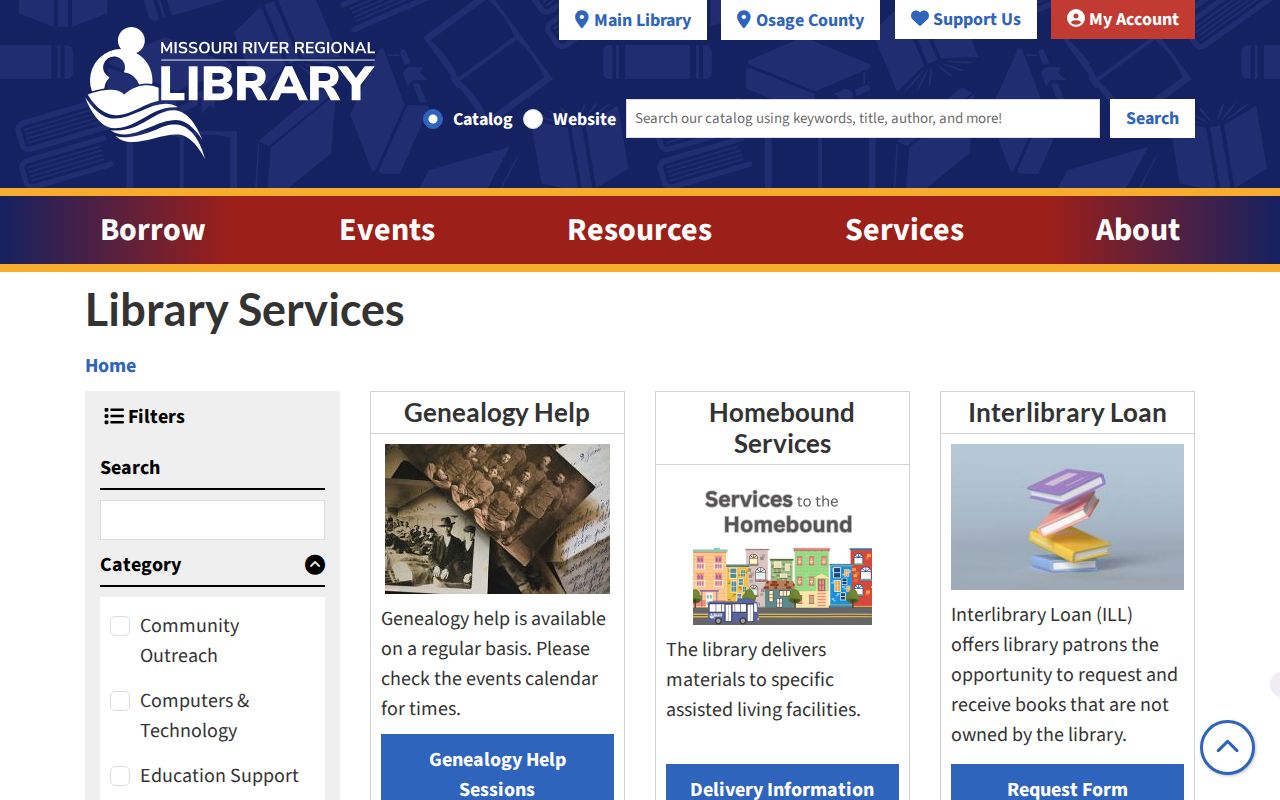
Ask the reference desk for the exact title and year before treating a catalog lead as a directory in hand. The public services page does not publish a year-by-year Jefferson City shelf list, a verified reverse-directory run, or the title and coverage of a local obituary index. It does identify the right local research desk for those questions.
Jefferson City Historical Records
Cole County Historical Society, 109 Madison Street, preserves photographs, artifacts, family material, and local-history research leads. Its office hours are Tuesday 1-3 and Wednesday and Thursday 10-3. Museum tours run Tuesday and Thursday 12-2:30 and by appointment. The library is open Monday 10-3 or by appointment. Call 573-635-1850 before traveling, especially for a directory, map, newspaper, or family-file request.
The Historical Society’s public research page is a useful contact route for Jefferson City local-history material.
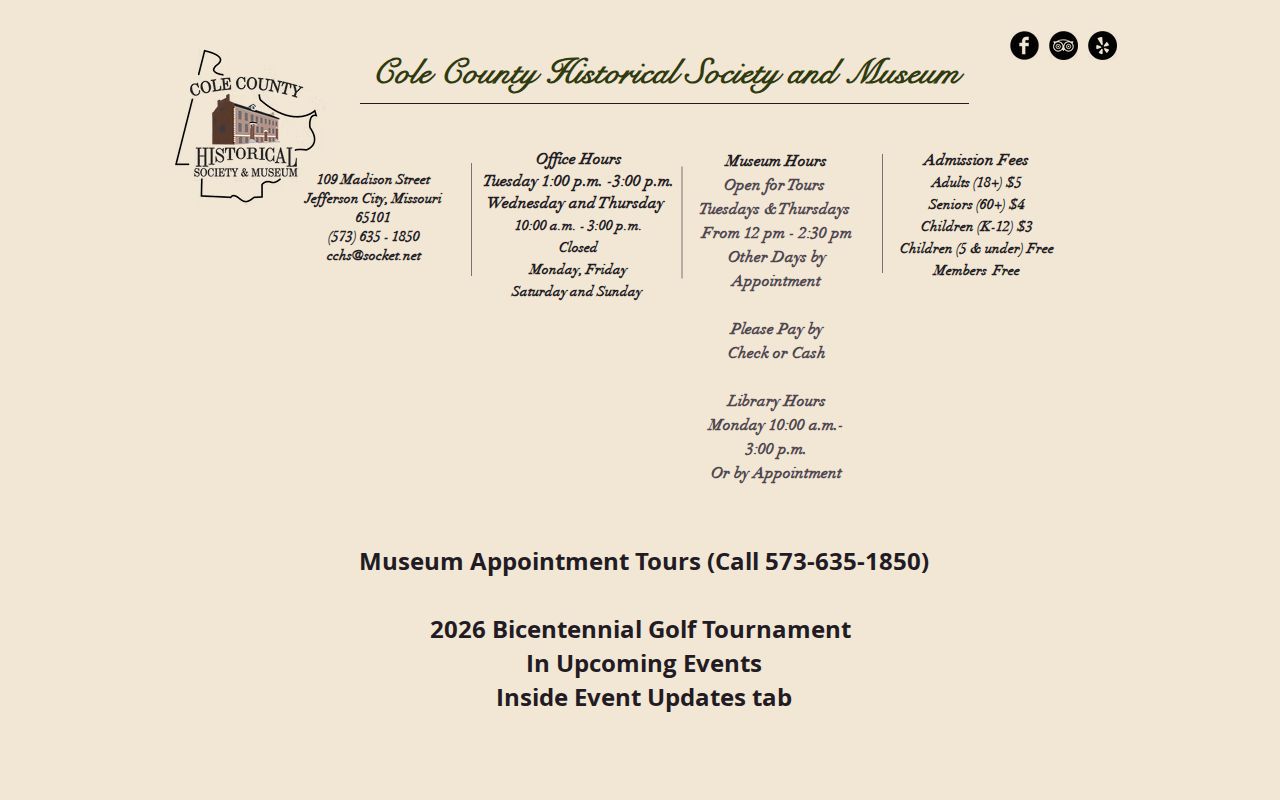
A complete local directory set is not confirmed on the public page. Ask about a defined surname, street, period, or publication type instead of assuming that the society holds every year. Its photographs, family files, and local maps can still help test a directory lead against a place and time.
Jefferson City Digital Records Lead
Missouri Digital Heritage’s city-directory hub describes the kinds of personal, business, and forwarding details that directories may contain. It is a statewide discovery resource, not proof that a particular Jefferson City year is online. Use it to identify collection context, then confirm the city, volume, title page, and image access before copying an entry into a research file.
The Missouri Digital Heritage directory collection hub provides the statewide reference point for this Jefferson City historical search.
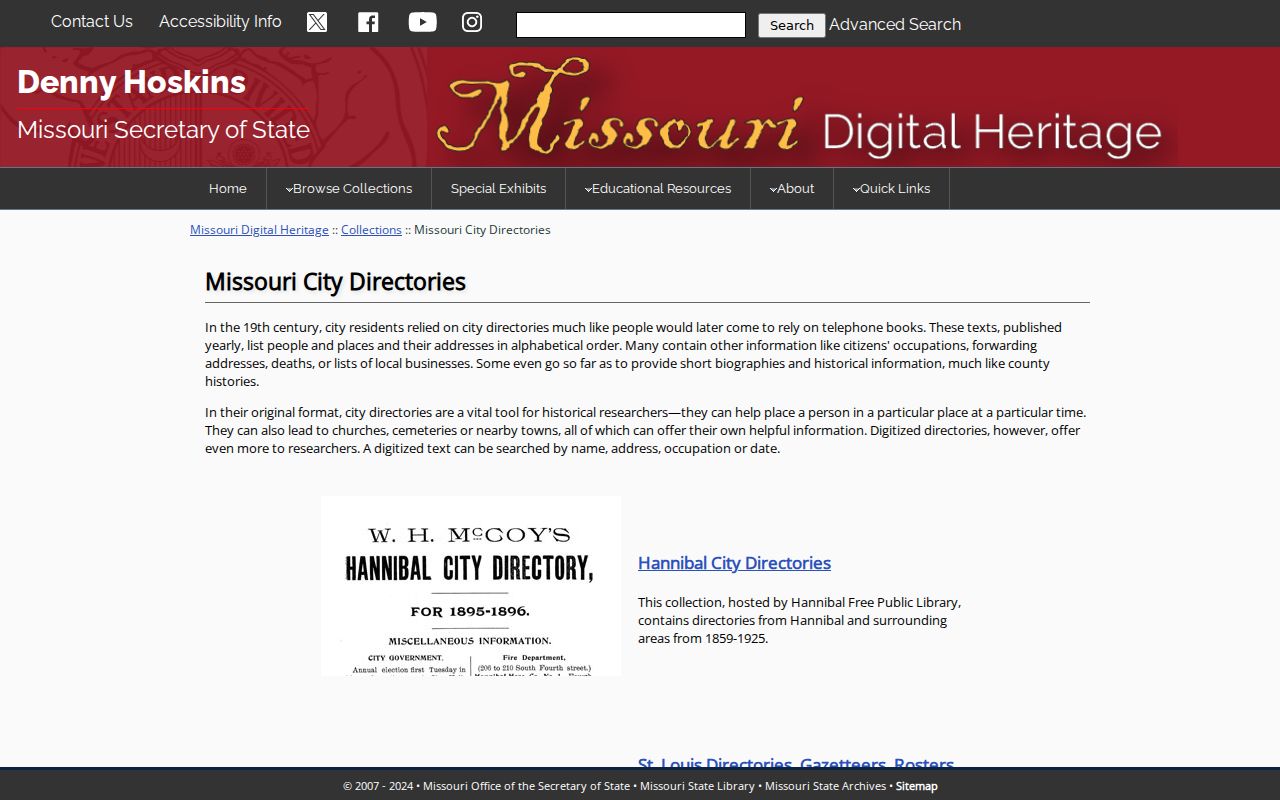
The practical fallback is local: ask MRRL, SLCL, or the Historical Society what is available for the target year and format. For earlier county and municipal records, the Missouri State Archives county-record guide and the Cole County reel inventory can point to a specific record group or physical reel.
Reading Jefferson City Entries
No machine-readable image of an actual Jefferson City entry was available in the official research sources. Read every local volume on its own terms. The title page, introductory material, and abbreviation key control what a line means. The inspection list below is a capture checklist for a volume opened at a library, not a claim that every local directory printed each field.
| Alphabetical name line | Copy the name exactly, including initials, spouse notation, or a business name if printed. |
|---|---|
| Address or street reference | Record the wording as printed, then compare it to historic maps or plats if the address has changed. |
| Occupation, business, or telephone clue | Preserve it only when the local line shows it. Do not fill absent fields from a general directory guide. |
| Moved, widow, owner, or other mark | Photograph the mark and its definition only if the volume’s own key explains it. |
- Criss-cross directory
- An address-order section that can place entries by street rather than alphabetically, if the local volume includes one.
- Householder index
- A name-oriented list of people or households in a directory, subject to that volume’s editorial rules.
- Abbreviation key
- The volume’s explanation of shortened words or symbols. Photograph it before interpreting a shorthand entry.
Jefferson City's Directory Gaps
A missing entry can reflect many things: the year may not be held, the volume may list a spouse, initials, a business, or a boarding-house notation, or the street may be abbreviated differently. It does not by itself prove that a person left Jefferson City. Search the alphabetical pages and any address-order pages in each available volume, then record the exact year that was checked.
The Library of Congress notes that historical directories can include personal, civic, religious, professional, and business information, but that is a general description. A local entry may be much sparser. The safest practice is to transcribe what appears, save the year and page reference, and separate observation from interpretation.
Jefferson City Records and Census
Pair a directory observation with a federal census release for the period being researched. The Missouri State Archives lists census material from 1830 through 1930, plus a 1940 image and Jefferson City street-index route. Census records describe a household on an enumeration date. A directory can record a subscriber, occupant, or business at compilation time. They work best as two dated observations, not as interchangeable proof.
Historic addresses may need a second translation step. Official local history material identifies Sanborn map leads for 1885, 1892, 1898, 1916, 1923, and 1939, and a 2022 historic-district record documents using a Sanborn map when addresses had changed. No direct official viewer for a Jefferson City sheet was located. Use the old street wording with a plat, Recorder description, or historic context before matching it to a current parcel.
For a modern address-record path after the historical work is complete, the Jefferson City street directory follows the assessor, parcel, and deed chain without trying to turn a historical listing into a current household record.
Tracing Jefferson City Records
Begin with one fixed fact, such as a name, known street, or the newest held directory year. Then build a dated trail. The goal is not to make every gap disappear. It is to preserve a sequence that another researcher can repeat at the same collection, with the same spelling and the same source dates.
- Find the newest available volume that fits the question and copy the name, street wording, relative notation, phone, business, and any printed mark exactly.
- Move backward one available volume at a time. Check alphabetical pages and any address or criss-cross portion because a person may appear under initials, a spouse, or a business.
- Mark every unheld year as a collection gap. Do not convert a gap into a move, death, or arrival date.
- Compare each observation with the appropriate released census, then use deeds, tax cards, permits, obituaries, or probate for independently dated support.
- When the historic street no longer matches today’s map, bridge it with Sanborn material, plats, the historic context, and the Recorder’s legal description.
MRRL and the Historical Society are the local follow-up points for newspaper, yearbook, obituary, and family-history leads when the published directory years stop. The State Archives adds county reels, death indexes, and census material. A name that disappears may have moved, died, remained unlisted, or simply fallen in a gap, so the next source should be chosen by the date and the known address rather than by guesswork.